 Free quote
Free quote
Free quote
Drainage & Water Management
French drains, flood mitigation and pond expansion across Montgomery and Walker Counties. Built for East Texas clay. Call (936) 648-2843.
Water is the other half of the storm problem. The wind takes the trees that were already compromised; the water is what compromised them. On heavy clay with a perched water table, rain does not soak away — it sits at the surface, moves across it, and saturates the ground that mature trees are standing in.
So alongside the tree work we take on drainage: French drains, flood mitigation and pond expansion, quoted per property after someone has walked it.
Call (936) 648-2843 to talk through what your ground is doing.
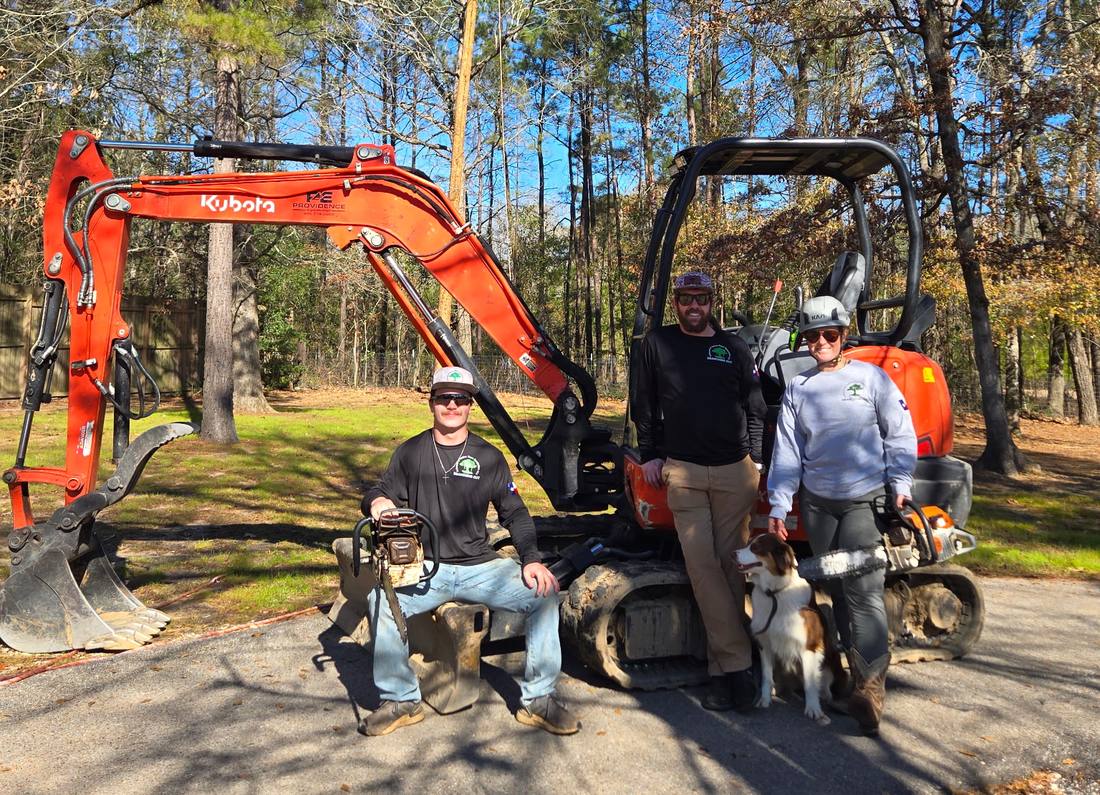
Because on a wooded property they are the same job. A tree is the tallest part of a system that includes the soil, the grade and the water moving through both, and pulling on one end of that moves the other.
Take a mature tree out and the site sheds water differently the next week. The canopy that was intercepting rain before it hit the ground is gone. The root system that was drinking a meaningful volume every day is gone. The ground under where it stood is disturbed and will settle. None of that shows up on a dry week and all of it shows up in a six-inch rain.
It runs the other way too. Saturated ground is where big trees fall over rather than break, because the root plate lifts instead of the trunk failing. If a tree keeps leaning in the same corner of a property after every storm, the tree is usually not the problem — the water is.
The practical version: we are already on the property with the machine, already looking at the grade, and already the ones who will be back if a tree comes down in the wet spot nobody fixed.
Montgomery and Walker Counties sit on heavy clay and clay-loam. Clay has very slow internal drainage, so water that gets in moves down at a crawl and often does not move down at all — it perches on a denser layer and sits there.
Two consequences drive most of the work:
Add a slab, a driveway and a compacted lawn to that and a property can shed a great deal more water than the ground it sits on ever handled.
A French drain is perforated pipe laid in a gravel trench, wrapped in filter fabric so the surrounding soil does not silt the stone up. On sand it is straightforward. On clay it is unforgiving, and the failures are always the same two things.
It needs fall. Water in the trench moves because the trench drops, not because the pipe is there. A drain run flat across a yard is a gravel-filled ditch that holds water instead of moving it.
It needs somewhere to go. The outfall is the whole design. A drain has to daylight somewhere lower, tie into something that leaves the property, or reach a point where water can spread and soak without simply reappearing. A trench that ends in the middle of the same clay it started in fills up and stays full.
Get those wrong and you have buried a problem rather than solved one — which is why the assessment comes before the price, and why we would rather tell you a drain is the wrong answer than sell you one.
Often the fix is not a pipe at all. Moving water off a structure, a septic field or a driveway is frequently a matter of shaping the ground: a shallow swale to intercept sheet flow, a corrected grade so water leaves a foundation instead of collecting against it, a berm to hold runoff back from where it does damage.
One rule we hold to: water you move has to go somewhere reasonable. Solving a wet corner by routing it onto the neighbouring property is not a solution, it is a dispute, and it tends to arrive later with a lawyer attached.
Ponds silt in. A pond dug thirty years ago has been catching sediment ever since and is usually shallower and smaller than it started, which costs it both capacity and depth. Expanding one gives you back storage — useful if the pond is doing real work holding runoff — and depth, which matters for how it behaves through a hot summer.
The part people underestimate is the spoil. Enlarging a pond generates a great deal of material that has to go somewhere on the property, and where it goes changes the grade, which changes the drainage. That gets planned before the machine starts, not after.
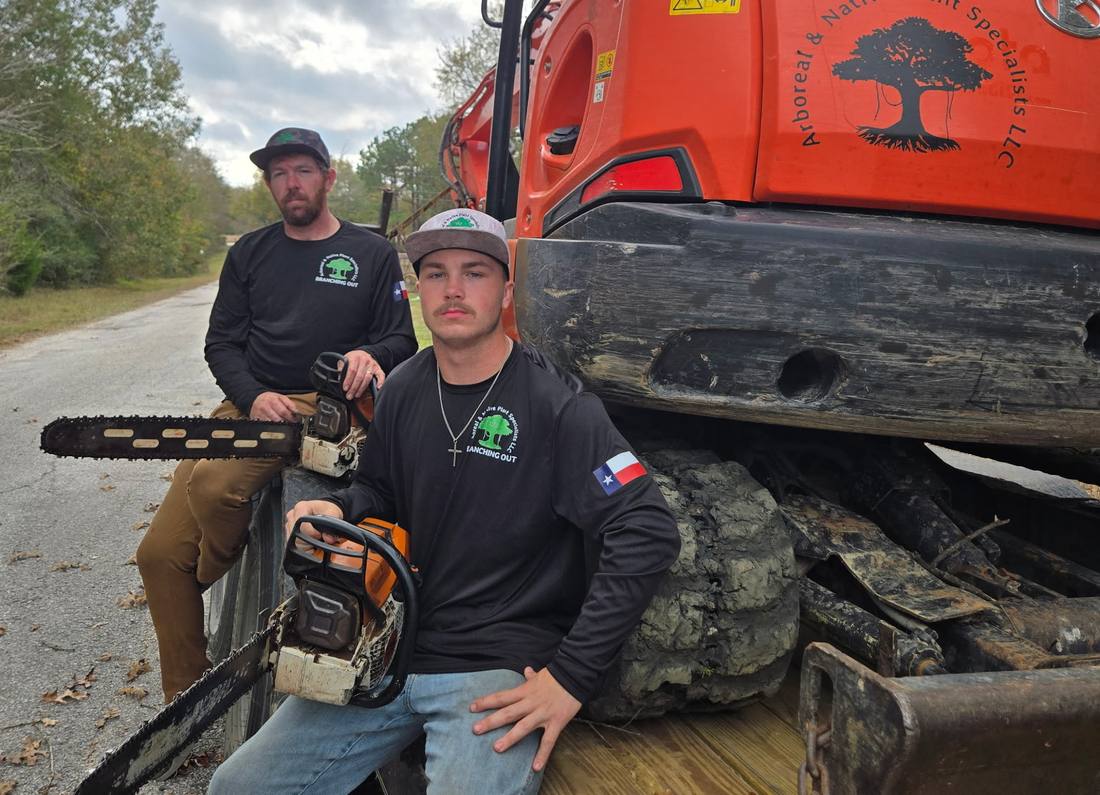
We run a mini track hoe, and on this kind of property that is the difference between a job being possible and being destructive. It fits through gates, works between mature trees without taking out the roots you are trying to keep, and spreads its weight instead of rutting a lawn into ruin. A full-size machine will finish faster and leave you with a repair bill for everything it drove over.
Included
Typical range: Quoted per property
Reviews
I can’t say enough great things about this company! They were incredibly friendly, professional, and truly a breath of fresh air to work with. They safely removed a dead tree from my property and even went above and beyond by neatly stacking the wood for me to use as firewood this year. Their prices were very fair, and the quality of their work exceeded my expectations. The Arborist (billy) helped me identify every tree on my property. If you’re looking for a reliable, honest, educated and skilled tree service, I highly recommend Branching Out Arboreal and Native Plant Specialists — you won’t be disappointed!Victoria Tillman · 8 months ago
Branching Out did an amazing job removing a dangerously dead pine tree from our backyard. The tree was right next to power lines, a transformer pole, fences, and close to our home, so it was a very difficult removal with almost no room for error. The tree was so dead it was basically crumbling while they climbed it, but their crew handled everything safely and professionally without causing any damage at all. What made the job even more difficult was that another healthy tree had actually started growing out of the dead pine, and they were able to carefully remove the pine while saving the healthy tree as well. A few weeks later, another company working nearby actually dropped a tree into power lines and took down a transformer pole — which made us even more grateful we hired Branching Out. These guys clearly know what they’re doing. Highly recommend them for any tree removal or dangerous tree work.Kenzi Standley · 2 months ago
First I want to say Branching Out is a professional company. After talking to Billy he sent me a printed quote for the work we had viewed and discussed . He removed three trees for us. His price was far more reasonable than the three other verbal quotes I had received. Also the other companies came back with lower offers after their bids were rejected. The bids were still not as low as Branching Out. The job was done super well and we enjoyed working with his whole crew, including his associate Tyler who did the stump grinding.Judy Price · a month ago
They did an excellent job cutting down a tall dead pine that was in a tight spot—no one’s favorite thing to do! Great communication, friendly, professional, and courteous. We had a challenge finding someone to service our area, so we are grateful and would highly recommend.everyotherone12 · a year ago
I was trying to save a tree and most companies want to just cut them down. But Kat & Billy went over and beyond to help me save my tree. They had to cut off alot more of the rotton branches than expected. But at least I should be able to keep this tree for were hoping another 5 yrs so I have time to get another one planted and growing before I lose this one. It's my only shade tree. They were very reasonable in thier prices and very knowledgeable. Would definitely use them again and refer them out. Thanks guysKim Taylor · a year ago
Reviews from Google · read them all
Coverage
Questions
Yes, if it has fall and a real outfall. Clay is not a reason to avoid a French drain; it is the reason the design has to be right. Most of the failed drains we are asked to look at failed for one of those two reasons rather than because of the soil itself.
Expansion of an existing pond is the common request and what most properties here need. Whether a new pond makes sense depends on the site, the soil and where the water is coming from, so ask and we will tell you honestly after looking rather than over the phone.
Usually, and it is normally cheaper that way. The machine is already on site, the access route is already planned and the ground is already going to be disturbed. If a removal is happening in the same area as a wet spot, doing both in one visit avoids paying twice for mobilisation and twice for cleanup.
Per property, after a look. Fall, distance, soil, access, where the outfall can go and how much material has to move all change the number by more than any rate card can capture. You get a written price before anything is dug.
Call (936) 648-2843 or send a message through the contact page.
Get in touch
Call and talk to someone who does the work, or send the details and we'll get back to you.
Call (936) 648-2843