 Free quote
Free quote
Free quote
Grimes County
Tree removal, pruning and storm work in Navasota and Grimes County — river-bottom pecans, post oak pasture, old town lots. 24/7 emergencies.
Navasota sits where Grimes County changes character. To the east the ground rolls up into post oak country that looks a lot like Walker County. To the west and south it drops toward the Navasota and Brazos river bottoms, where the soil is deep alluvium and the trees are pecans, cedar elms, hackberries and big bottomland oaks. A tree service working here has to know both, because a property on the edge of town can have a little of each.
Call (936) 648-2843 for anything in Navasota, Anderson, Plantersville or the rest of Grimes County. Storm calls are answered 24/7.
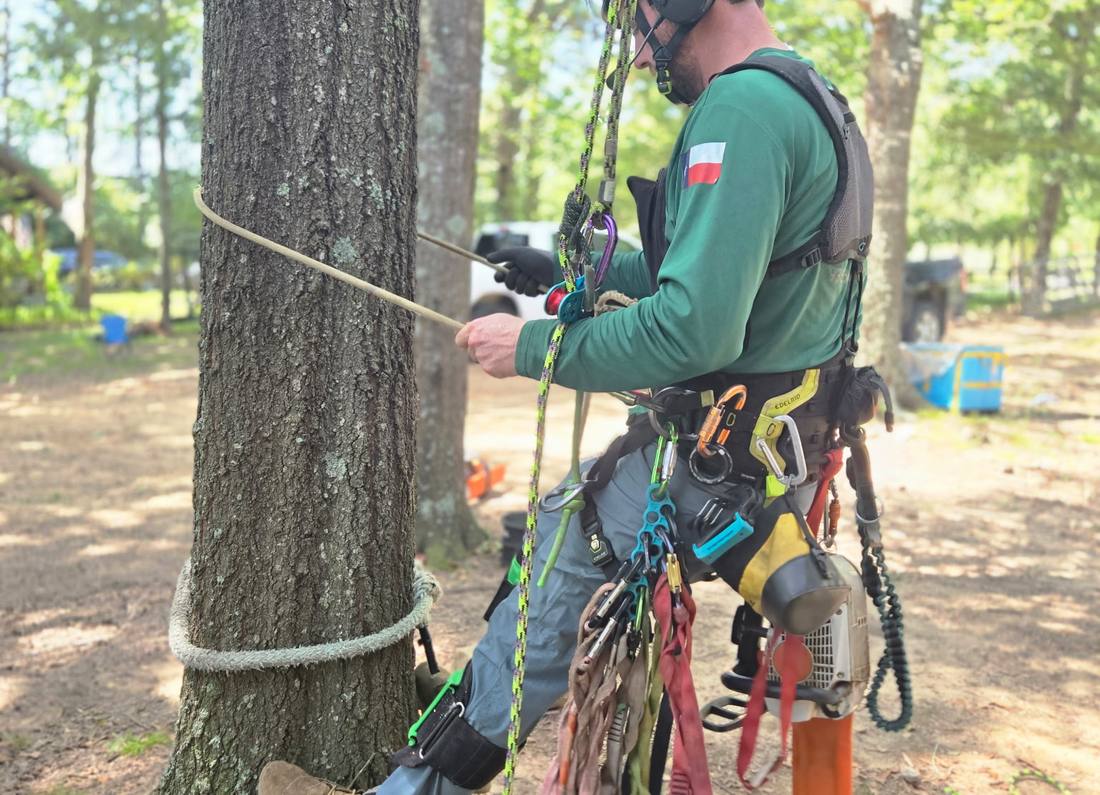
Navasota's older streets carry the kind of canopy that only comes with time: live oaks and pecans planted by people who are long gone, standing over houses that were built before anyone thought about where a tree would be in eighty years. The trees are now the size of the houses, and some of them are bigger.
Pecan is the one to watch. It is a beautiful shade tree and a poor structural one once it is old. The wood is brittle, the limbs are long and heavy, and a mature pecan sheds big wood in wind or under its own weight on a still summer afternoon. Thinning the crown and removing the long, over-extended limbs reduces that load without taking the tree. Taking it out is a last resort, and on most of these lots it has to come down in pieces anyway, because there is a house, a fence and a neighbor on three sides.
Live oaks are tougher, but the old ones carry decades of deadwood and the odd cavity where a limb was lost long ago. Deadwood removal and clearance over roofs and drives is the routine work, and it is cheap compared with the alternative.
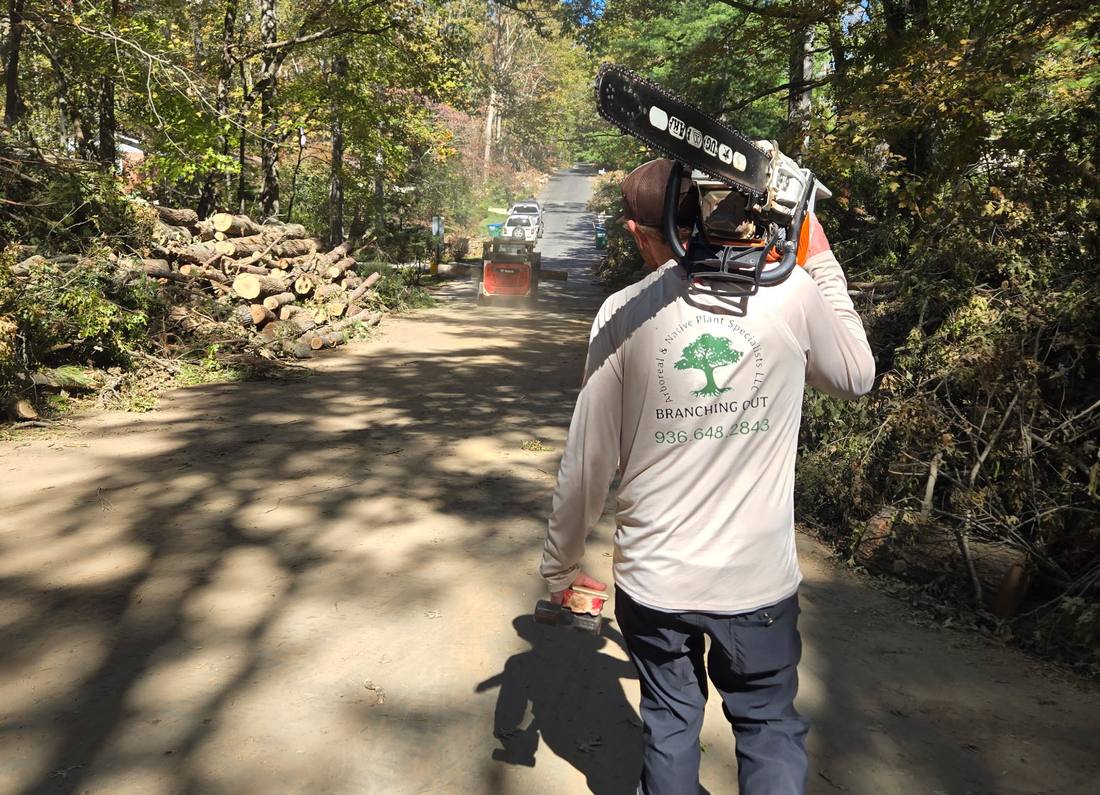
Out toward the rivers, the trees grow fast and big on deep soil with water close underneath. That produces large hardwoods with wide crowns and, in a lot of cases, shallow root systems that never had to go looking for water. When a tropical system parks over the Brazos valley and the bottoms stay wet for a week, those trees can go over whole.
Flooding brings its own set of problems. Standing water for a few days is survivable for most bottomland species, which are built for it. Weeks is not, and a tree that drowned slowly often leafs out the next spring and then declines through the summer. If a property flooded, the trees on it are worth a second look a year on, before one of them decides the question for you.
East of town and up toward Anderson, the land is ranch and pasture, and the tree work follows the fences. Post oaks along a fence line drop limbs onto the wire. Eastern red cedar and yaupon move into open pasture if nobody stops them, and Chinese tallow takes over wet corners and stock tank banks faster than almost anything else in this part of Texas.
Clearing a fence line, opening up a pasture that has grown in, and controlling tallow and privet before they spread are all part of the work here. So is the other half of it: deciding which post oaks to leave. A big, sound post oak in a pasture is shade for cattle, it is slow-grown and strong, and it is worth keeping. It is also sensitive to having its root zone disturbed, so it is worth keeping equipment and new construction out from under it.
The uplands around Navasota are sandy loam over clay, and the clay layer is close enough to the surface to matter. Water perches on it in a wet spell and the ground dries hard in a drought. Post oaks handle that well until something changes around them: a new driveway, a house pad, a load of fill spread over the roots, a trench for a water line. Then they decline over several years and nobody connects the decline to the work that caused it.
If you are building on a lot with good post oaks, the time to plan for them is before the dirt work starts, not after the tree starts thinning at the top.
Services
Reviews
I can’t say enough great things about this company! They were incredibly friendly, professional, and truly a breath of fresh air to work with. They safely removed a dead tree from my property and even went above and beyond by neatly stacking the wood for me to use as firewood this year. Their prices were very fair, and the quality of their work exceeded my expectations. The Arborist (billy) helped me identify every tree on my property. If you’re looking for a reliable, honest, educated and skilled tree service, I highly recommend Branching Out Arboreal and Native Plant Specialists — you won’t be disappointed!Victoria Tillman · 8 months ago
Branching Out did an amazing job removing a dangerously dead pine tree from our backyard. The tree was right next to power lines, a transformer pole, fences, and close to our home, so it was a very difficult removal with almost no room for error. The tree was so dead it was basically crumbling while they climbed it, but their crew handled everything safely and professionally without causing any damage at all. What made the job even more difficult was that another healthy tree had actually started growing out of the dead pine, and they were able to carefully remove the pine while saving the healthy tree as well. A few weeks later, another company working nearby actually dropped a tree into power lines and took down a transformer pole — which made us even more grateful we hired Branching Out. These guys clearly know what they’re doing. Highly recommend them for any tree removal or dangerous tree work.Kenzi Standley · 2 months ago
First I want to say Branching Out is a professional company. After talking to Billy he sent me a printed quote for the work we had viewed and discussed . He removed three trees for us. His price was far more reasonable than the three other verbal quotes I had received. Also the other companies came back with lower offers after their bids were rejected. The bids were still not as low as Branching Out. The job was done super well and we enjoyed working with his whole crew, including his associate Tyler who did the stump grinding.Judy Price · a month ago
They did an excellent job cutting down a tall dead pine that was in a tight spot—no one’s favorite thing to do! Great communication, friendly, professional, and courteous. We had a challenge finding someone to service our area, so we are grateful and would highly recommend.everyotherone12 · a year ago
I was trying to save a tree and most companies want to just cut them down. But Kat & Billy went over and beyond to help me save my tree. They had to cut off alot more of the rotton branches than expected. But at least I should be able to keep this tree for were hoping another 5 yrs so I have time to get another one planted and growing before I lose this one. It's my only shade tree. They were very reasonable in thier prices and very knowledgeable. Would definitely use them again and refer them out. Thanks guysKim Taylor · a year ago
Reviews from Google · read them all
Nearby
Questions
Yes. Grimes County borders Walker County and it is part of the area we cover. Call and describe what you have, and we will work out what makes sense, whether that is one tree over a roof or a pasture full of tallow.
Not necessarily. Pecans shed wood, and one dropped limb does not mean the tree is failing. It does mean the crown is worth looking at: where the limb tore out, how much weight is on the other long limbs, and whether there is decay at the break. Often the answer is a reduction prune, not a removal.
Sometimes, and sometimes the right answer is to wait. Heavy equipment on saturated clay or alluvium leaves ruts that last for years and compacts the root zones of the trees you are keeping. Where a tree is a hazard it gets dealt with, with lighter gear and more rope work if that is what it takes. Where it can wait a week for the ground to firm up, it should.
Yes. Fence-line clearing, pasture reclamation, invasive control and hazard trees along drives and barns are a big part of the work in Grimes County. Every property is quoted after someone has walked it, because forty acres outside Anderson and a quarter-acre lot in town are not the same job.
It depends which half of Grimes County you are in. On the sandy upland lots, post oak, cedar elm, Texas redbud and yaupon (the native shrub, kept in its place) handle the clay underneath and the August heat once they are established. On wet, river-bottom ground, bald cypress, swamp chestnut oak and possumhaw holly suit the conditions instead of fighting them. Around a house, a pollinator bed of Turk's cap, coneflower and milkweed fills the sunny gap a removal leaves and needs far less water than lawn. The point is to put something back that belongs on that soil, so the spot does not simply grow up in tallow and privet the year after the tree is gone.
Call (936) 648-2843, day or night for storm damage.
Get in touch
Call and talk to someone who does the work, or send the details and we'll get back to you.
Call (936) 648-2843