 Free quote
Free quote
Free quote
Trinity County
Tree removal, pruning and storm work in Trinity, Groveton and Trinity County — Lake Livingston lots, pine woods, river bottom. 24/7 emergencies.
Trinity County is pine woods, river bottom and lake. The town of Trinity sits near the north end of Lake Livingston and the Trinity River, Groveton is the county seat up the highway, and a large share of the county is forest, including part of the Davy Crockett National Forest. Properties here run from town lots with old shade trees to lake houses under tall pines to wooded acreage that has not been touched in decades.
Call (936) 648-2843 for anything in Trinity, Groveton, Apple Springs, Centralia or anywhere else in Trinity County. Storm calls are answered 24/7.
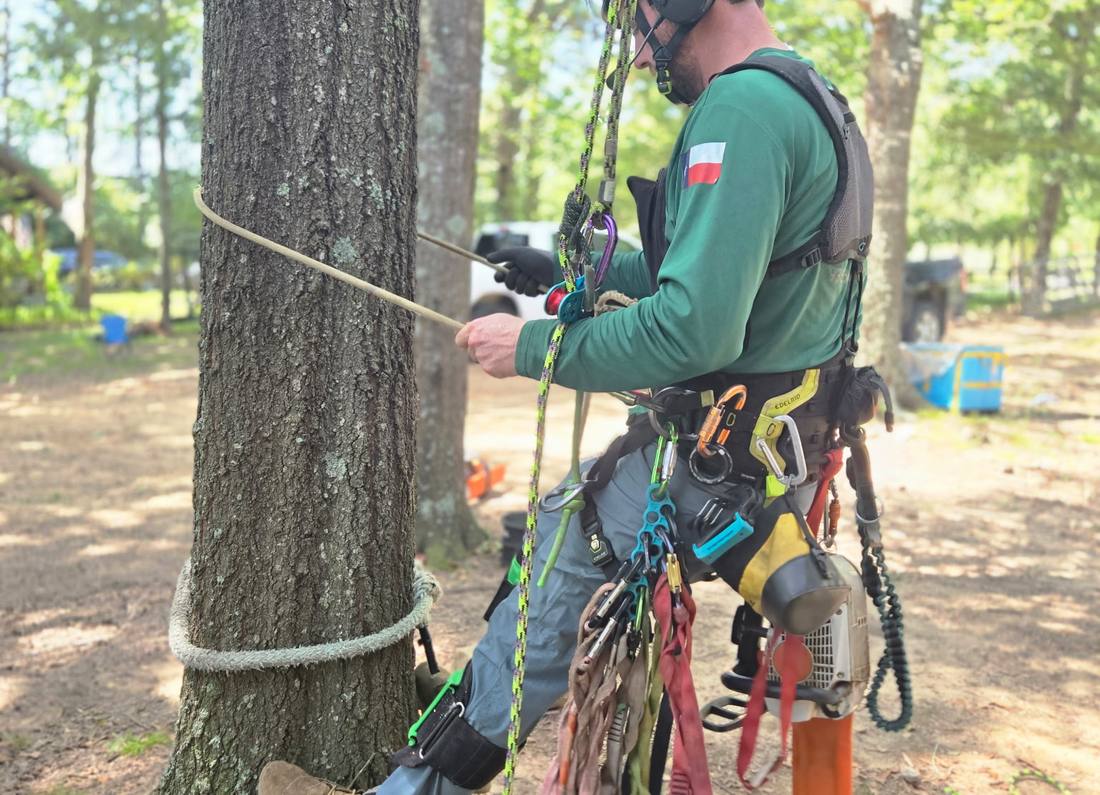
The lake is what sets this area apart. A house on or near Lake Livingston usually sits on a narrow lot under tall pines and big hardwoods, with the water on one side and a neighbor close on both others. That makes almost every removal a sectional job, taken down in pieces on ropes, because there is nowhere to drop a tree that does not have a roof, a boathouse, a dock or a power line in the way.
Wind matters more on the water. Trees along the shoreline take the full fetch of the lake in a storm, and a pine that grew up sheltered in the woods is a different tree once the lot around it is cleared for a view. Shoreline trees also hold the bank. Taking every tree off a waterfront lot for the view is a reliable way to start losing the bank itself, so the work there is about choosing which trees come out and which stay, and what goes in where something has to be removed.
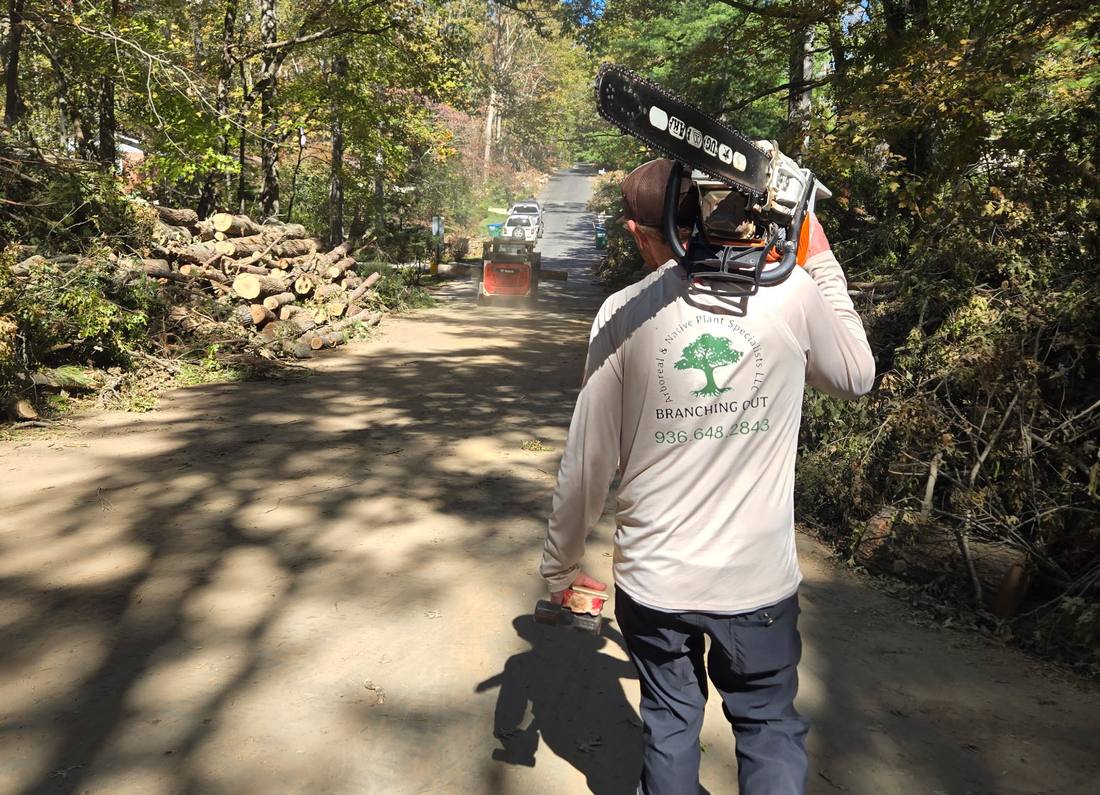
Away from the water, much of Trinity County is pine forest, and a homesite is a clearing in it. Trees that grew up crowded together are tall and thin, with small crowns and modest root plates, and they rely on each other for shelter from wind. Open a stand for a house, a drive or a garden, and the trees on the new edge are suddenly standing alone in weather they were never built for.
That is why so many storm calls in pine country are healthy-looking trees that went over whole. Selectively thinning the tall, leaning stems near the house while keeping the sturdier trees as a windbreak holds up far better than clearing everything or leaving everything.
The woods also bring invasives. Chinese privet fills the understory, Japanese climbing fern climbs into the shrubs and young trees, and Chinese tallow moves into anything wet. Controlling those and letting native growth come back gives you woods instead of a thicket.
Toward the Trinity River the ground drops into bottomland, and the trees change with it: water oaks, willow oaks, sweetgum, cypress near the water, and big hardwoods on deep, wet soil. Bottomland trees tolerate flooding, but not without limit. After a long high-water event, trees that sat in water for weeks can leaf out the following spring and decline through the summer, so a flooded property is worth a second look a year later.
Wet ground also limits when heavy equipment can work without rutting the site and compacting the roots of the trees you want to keep. When something is a hazard, it gets handled with more rope and lighter gear. When it can wait for the ground to firm up, it should.
Tropical systems coming up from the coast still bring strong wind and heavy rain this far inland, and the lake gives that wind a long, open run. Spring storm lines bring straight-line wind and the occasional tornado warning. Pines loaded with rain in saturated soil are the trees that fail first.
The calls that matter most after a storm are a tree on a house, a tree blocking the only road out, and a limb hung up over where people walk. We answer the phone 24/7, because those calls do not wait for the morning.
Services
Reviews
I can’t say enough great things about this company! They were incredibly friendly, professional, and truly a breath of fresh air to work with. They safely removed a dead tree from my property and even went above and beyond by neatly stacking the wood for me to use as firewood this year. Their prices were very fair, and the quality of their work exceeded my expectations. The Arborist (billy) helped me identify every tree on my property. If you’re looking for a reliable, honest, educated and skilled tree service, I highly recommend Branching Out Arboreal and Native Plant Specialists — you won’t be disappointed!Victoria Tillman · 8 months ago
Branching Out did an amazing job removing a dangerously dead pine tree from our backyard. The tree was right next to power lines, a transformer pole, fences, and close to our home, so it was a very difficult removal with almost no room for error. The tree was so dead it was basically crumbling while they climbed it, but their crew handled everything safely and professionally without causing any damage at all. What made the job even more difficult was that another healthy tree had actually started growing out of the dead pine, and they were able to carefully remove the pine while saving the healthy tree as well. A few weeks later, another company working nearby actually dropped a tree into power lines and took down a transformer pole — which made us even more grateful we hired Branching Out. These guys clearly know what they’re doing. Highly recommend them for any tree removal or dangerous tree work.Kenzi Standley · 2 months ago
First I want to say Branching Out is a professional company. After talking to Billy he sent me a printed quote for the work we had viewed and discussed . He removed three trees for us. His price was far more reasonable than the three other verbal quotes I had received. Also the other companies came back with lower offers after their bids were rejected. The bids were still not as low as Branching Out. The job was done super well and we enjoyed working with his whole crew, including his associate Tyler who did the stump grinding.Judy Price · a month ago
They did an excellent job cutting down a tall dead pine that was in a tight spot—no one’s favorite thing to do! Great communication, friendly, professional, and courteous. We had a challenge finding someone to service our area, so we are grateful and would highly recommend.everyotherone12 · a year ago
I was trying to save a tree and most companies want to just cut them down. But Kat & Billy went over and beyond to help me save my tree. They had to cut off alot more of the rotton branches than expected. But at least I should be able to keep this tree for were hoping another 5 yrs so I have time to get another one planted and growing before I lose this one. It's my only shade tree. They were very reasonable in thier prices and very knowledgeable. Would definitely use them again and refer them out. Thanks guysKim Taylor · a year ago
Reviews from Google · read them all
Nearby
Questions
Yes. Trinity County touches Walker County, and we cover every county that does. Call and tell us what you have, whether that is a lake lot in Trinity or acreage outside Groveton.
Some of them, usually, but not all. The trees nearest the water are holding the bank, and the trees around the house are sheltering each other from wind. A view can almost always be opened by removing selected trees and raising the canopy on others, without stripping the lot and inviting erosion.
If the lean is new, treat it as one. Fresh lean, cracked or lifted soil at the base and exposed roots on the far side all mean the root plate has moved. Keep people out of the fall zone in every direction and call us, day or night.
That is the point of sectional removal. The tree comes down in pieces lowered on ropes into the space that is available, rather than being dropped and hoping for the best.
Where a shoreline tree has to come out, something with roots needs to replace it, or the bank starts to go. Bald cypress is the classic choice right at the water's edge. Buttonbush, possumhaw holly and wax myrtle hold soil a little further up, and native grasses and sedges fill the gaps between them. Further back, oaks and pines that suit the sandy loam take over. The aim is a bank that holds itself together with living roots instead of riprap, keeps a view open, and does not need mowing down to the waterline every week. It is planting work that most tree services will not touch, and it is one we do.
If a lake lot has already lost trees along the water and the bank is starting to cut back, the sooner something with roots goes in, the less ground is lost before it takes hold.
Call (936) 648-2843, day or night for storm damage.
Get in touch
Call and talk to someone who does the work, or send the details and we'll get back to you.
Call (936) 648-2843